

edvse.over-blog.com/
18 Janvier 2021

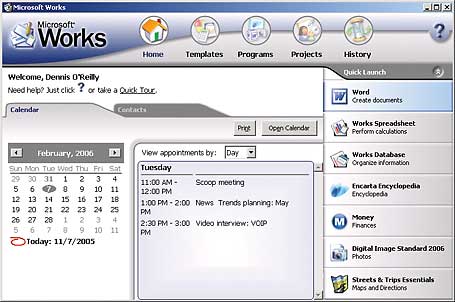
Microsoft Works is a Commercial software in the category Home & Hobby developed by Microsoft. It was checked for updates 8,985 times by the users of our client application UpdateStar during the last month. The latest version of Microsoft Works is 9.7.0621, released on. It was initially added to our database on.
Corrupted works database files are files that suddenly become unusable and can't be opened with Microsoft Works Database. There are several reasons why a works database file may have been damaged. In some cases, it is possible to fix and recover the corrupt wdb (Works Database 9.0, 8.0, 7.x, 6.x, 5.x) file. Get the latest updates available for your computer's operating system, software, and hardware. We will scan your computer and provide you with a selection of updates tailored just for you.
With MicrosoftWorks Suite 2004 you get six incredible Microsoft™ programs, including MicrosoftWorks, Microsoft Word, Microsoft Money Standard, Microsoft Encarta™ Encyclopedia Standard, Microsoft Streets & Trips, and Microsoft Picture It!™. ..
When you install this update, you are enabling Microsoft Word 2002 to connect to translation services provided by WorldLingo. Translation can be performed between Chinese, English, French, German, Italian, Japanese, Korean, Portuguese, Russian, and. ..
The Microsoft Product Support Services Security Team is issuing this alert to inform customers about a new worm named W32.Blaster.Worm which is spreading in the wild. This virus is also known as: W32/Lovsan.worm (McAfee), WORM_MSBLAST.A (Trendmicro),. ..
This information applies to Microsoft Exchange 2000 Server. Sometimes you need to reset the directory synchronization (dirsync) sequence numbers when you are troubleshooting Microsoft Mail directory synchronization problems with a Microsoft Exchange. ..
The Publisher 2002 Update: June 21, 2001 provides increased performance. A Web page created with Publisher 2002 is larger than a similar Web page created with an earlier version of Publisher, which can cause slower uploading and downloading of the. ..
This downloadable file contains the most current Microsoft Word 2002 Help files and replaces the existing This downloadable file contains the most current Microsoft Word 2002 Help files and replaces the existing ones.
Recovery for Works is a powerful data recovery software for corrupted MicrosoftWorks files (.WPS, .XLR, .WDB). Recovery for Workscomponents restoreWorks Wordprocessor documents, Works Spreadheets and Works Databases. Supports MS Works 5.x/6.x/7.x. ..
This application converts old Microsoft Works Database (*.wdb) files (e.g.
When you attempt to print a calendar that is integrated with your MicrosoftWorks Calendar in Microsoft Home Publishing 2000, you may receive the following message:'Please wait while the Calendar prepares to print' An animated printer icon is. ..
When you attempt to print a calendar that is integrated with your MicrosoftWorks Calendar in Microsoft Home Publishing 2000, you may receive the following message:'Please wait while the Calendar prepares to print' An animated printer icon is. ..
When you attempt to print a calendar that is integrated with your MicrosoftWorks Calendar in Microsoft Home Publishing 2000, you may receive the following message:'Please wait while the Calendar prepares to print'An animated printer icon is. ..
MS Works Converter 2.20 is a useful program which allows you to convert MicrosoftWorks files (extension wks and wdb) to Excel format.MS Works Converter can convert great numbers of Works files in one go. Microsoft does not provide an import filter. ..
Databases arecollections oforganized information.. the phone book (white pages) is a commondatabase. Databases are organized by records and fields.
-- Fieldsand thecategories of information.. in the phone book, name,address, &phone number
-- a Recordis a set ofdata-- one for each field. Alan Zisman, 2684 E. 2nd, 713-4705would be one record in the phone book.
Unlike word processorsandspreadsheets, you really need to think about how to organize yourdatabase prior to entering data.. a database is notfree-form.Think about how you're likely to use your data-- if you wantto be ableto treat first and last names separately, you will need to have them inseparate fields. Similarly, you may want to separate street address,city, province, postal code (in an address-book database).
As well, before enteringdata,decide on a consistent manner.. if you made a database of your CDcollection, would you list artist Shania Twain as‘Twain,Shania'? How about Backstreet Boys?There are notnecessarily right answers.. but you need to be consistent.
We're going tocreate and use adatabase to list our (real or fictitious) music collection-- CDs,tapes,old LPs, etc. Start MS Works, and click to start a new database..You'll see:
We're beingprompted to add fieldsand (optionally) identify their>Title Artist Format Genre (alltext-format)
Year Rating (number-format,0decimalplaces)
(Whydidn't I pick Date-formatfor ‘Year'?)
When you'vepressed Add foreach of those fields, press Done.
(In older versions ofWorks, youaren't prompted to create fields-- instead, on the blankpage, to createa field, type the field-name followed by a colon: Title: You'llbeprompted to enter a size for the field-- themaximum numberof letters you expect to store).
You should see somethinglike this:
This is showing you youremptydatabase, looking something like a spreadsheet-- with the fields as thevertical columns, and each (empty) record as a horizontal row. Indatabase-speak, this is known asList View. Youcould enter yourdata this way.. but it might be easier to switch to FormView-- clickthe View menu's Formitemto see:
Here, you can enter thedata as ifon a paper form.. one record at a time. But this default formisn'tvery attractive.. we can spruce it up, by choosing View/FormDesign.
Here, you can drag thefieldsaround the page, change the font, size, and style used in the fieldname, enter other text, like a title or instructions, add borders,shading, graphics, etc. To make the dotted line for the data for eachfield larger or smaller, click on the dotted line and drag it to thedesired size, or use the Format/Field Size menuitem.
When you'vegotten a moreattractive form design, return to Form View (using the View/Formmenu item).
Now we can startentering data.Remember-- set rules for how to enter your data.. for instance:
Title: writeinitialwords like 'the' or'a' at the end: GreatestHits, The
Artist: forperson'snames, last name first: Twain,Shania
forgroups,group name, ‘the'last: Beatles, The Way of the wolf pdf.
Format: cassette,CD, LP,45, 8-track, other
Genre: pop,rock,metal,jazz, alternative, folk, classical, opera, etc
Year: 4-digityear 1995,not 95 or ‘95
Rating: a number from1 to 5, where 5 is best
To enter data, noticethat thefirst field is highlighted.. type your first title. You could move tothe next field by clicking with the mouse.. but instead, press the tabkey. Notice that pressingtabmoves you from field tofield.Holding down the shift key when you press tab movesyou backwards through the fields.
Notice the controls onthebottom-left of the window:
These tell you whatrecord you'recurrently working on, and let you move back and forth through therecords of your database:
|< movesyouto the very first record
< movesyouback one record
> movesyouforward one record
Sig sauer serial number decoder. >| movesyouto the last record
As well, when you enterdata inthe last field on the page, and press tab, you getan empty formfor the next record, ready to enter data. (Remember, shift +tabwill back you up to the previous record).
Enter data for fiverecords.. ifyou discover that you've made a mistake in how your fields orthe dataare appearing, you'll need to go back to Form Designview to makechanges.. for instance, if your dates are appearing as1995.00,you forgot to set the number of decimal points at‘0'. Go to FormDesign view, and click on the>Form view is perhaps theclearestway to enter data.. but it's less useful if you want to seeall thedata, and perhaps draw conclusions from it. Switch back to Listview (using the View/Listmenu item).
In list view, you cansort yourinformation in various ways.. alphabetically by title, or by Artist,orby year, or whatever.. with larger databases, it makes sense to sortbymultiple criteria-- perhaps by Year, then by Artist, then by Title.
Use the Record/SortRecordsmenu command to see:
Notice that you canchoose up tothree fields to sort, choosing them from drop-down lists (so youdon'thave to remember how to spell the field-names correctly!), and set eachascending or descending-- so you could sort with the earliest yearfirst(ascending) or the more recent first(descending).
Often, simple sortingwill giveyou valuable information.
For more detailedinformation, wemight want to ask the database a question. Older versions of Works callthis a Query. Works 4 calls it a Filter. (Inthe Toolsmenu).
Typically, you shouldfirst sortthe records, then apply a filter (or query).. that way, the filterresults will be sorted as desired. Check the following:
See how it would onlyshow recordsthat were Rap from the 1990s on CD (if any).. the results would showupin List view.
Sorts and Filters can beused toget all sorts of answers from a database.. and that's thewhole point--storing data is only valuable if you can convert it into information--data that answers a question, giving it meaning.
Another use fordatabases is inproducing reports-- in this case, a report is aprintout of someof your information. You may want to sort and filter your data beforeproducing a report.. the report would, in that case, show the resultsof those actions.
To produce a report,click on Tools/ReportCreator. (Earlier versions of Works made you do all thismanually,using Tools/Report). Give your report a meaningfultitle-- youcan save up to 8 reports with your database, and remembering which is Report6 is difficult!
The first window of theReportCreator looks like:
and simply checks thetitle, font,and how you want it to print-- vertically or horizontally. Nexttakes you to theFieldspage:
This lets you choosewhich fieldsyou want to appear in a report.. so a filter is a sub-set of therecords, a report gives a subset of the fields.
The next pages let yousort andfilter your records (if you haven't already done so). Thefinal pagelets you include some basic statistics about the data:
When Done,you'll see somethinglike this:
Previewgives you a PrintPreview screen, showing how the report will look when printed.. Lightroom preset mac torrent net. Modifygives you the above-page, without the dialogue box (which is also whatyou get when you leave Print Preview).
In this mode, you canmake thecolumns wider or narrower (drag the tabs on the top), change thetitle'sfont and size, etc.. preview the results before printing.
Other uses of databasesinvolvemerging their information with your word processor, for creating formletters, report cards, labels, etc.
Here, we want to firstcreate adatabase with the desired information.. with that file open,we'llmerge it with the word processor.
Let's use theMusic collectioninformation you previously created.
We're firstgoing to merge theinformation into a set of bogus-personalized fan letters.. so start anew word processor document.
Type the contents of atypicalgushy fan letter.. we want to tell Madonna (etc) how much we loved herCD Like a Virgin, and how it was our favorite CD ofthe year1988 (or whatever).. and automatically do the same for eachotherartist in the database.
Type your letter.. butwhere youcome to items like the artist's name, the CD name, the date(etc), don'ttype anything. Instead, from the Insert menu,choose DatabaseField. You'll see:
Click the Usea DifferentDatabase button to be able to select your database.. whenyou dothat, you'll get a list of the fields in that database:
Select a field, andclick the Insertbutton, followed by the Close button.. in yourtext, you shouldsee something like:
Dear<
Type punctuation afterthebrackets, and continue, inserting the appropriate database fields whereneeded.
When finished, PrintPreview.You'll be asked if you want to preview all database records--say ‘Yes'.Notice that you get your letter, with the database informationinserted.. clicking Nextshows you the next fanletter.
If you only wanted formletters tosome of the artists, filter the database first.
(In real life, you mightwant toprint.. not now, please!)
--Note: In Works 4 only,there's a Tools/FormLettermenu item, that helps walk you through the process.Similarly, let's take a look at the Tools/Labelsmenu item.. itasks you to choose between multiple copies of a single label, or labels..implyingprintinga sheet where each label uses a different databaserecord. Pick labels.
You get instructions,followed bya page allowing you to pick from standard label sizes or enter a customsize.. next, you're prompted to select a database, The Recipientspage lets you choose what you want to use from your database (again,youmay want to sort and filter the database first).
The LabelLayout page letsyou select the fields to use and the layout on the label, and shows youa sample label.. If you type text in the sample, it appears on everylabel-- for instance, a comma, in between City and Province fields inanaddress.
It's a goodidea to Preview andTest before printing.. use standard paper rather than label paper foryour tests.. maybe even do a test of one page of your label set, andline it up with your label paper to see if it seems to fit.
And remember to only uselabelpaper that's clearly marked as being appropriate for yourtype ofprinter-- laser or inkjet, for instance.. having labels come loose andstick inside your printer can be a real mess!


/image%2F6290001%2F20210118%2Fob_3989c4_state-of-decay-year-one-survival-editi.jpeg)
/image%2F6290001%2F20210118%2Fob_e21524_fuji-box-9100-hyper-software-download.jpeg)
/image%2F6290001%2F20210118%2Fob_fd6606_quickbooks-with-license-number.png)
/image%2F6290001%2F20210118%2Fob_1c5c02_adobe-flash-player-for-mac-os-109.jpeg)